

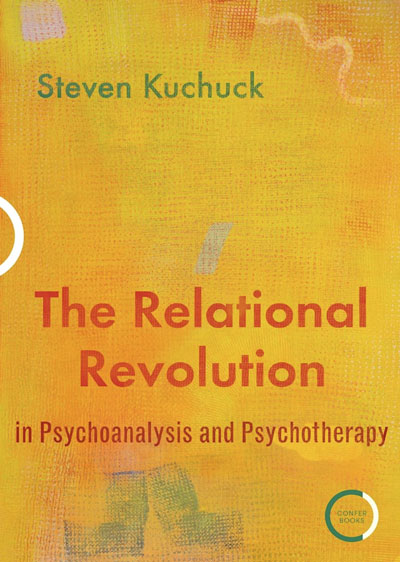
Interview with Steven Kuchuck on his book, The Relational Revolution in Psychoanalysis and Psychotherapy
By Berta Loret de Mola (Mexico)
Steven Kuchuck, DSW is Senior Consulting Editor (formerly Editor-in-Chief) of Psychoanalytic Perspectives, Associate Editor, Psychoanalytic Dialogues, Editor, Routledge Relational Perspectives Book Series, Immediate Past President of IARPP, faculty, NYU Postdoctoral Program in Psychotherapy and Psychoanalysis, Board Member and faculty/supervisor at NIP, and faculty/supervisor at the NIP National Training Program, Stephen Mitchell Relational Study Center and other institutes. Dr. Kuchuck’s teaching and writing focus primarily on the clinical impact of the therapist’s subjectivity. His most recent book is The Relational Revolution in Psychoanalysis and Psychotherapy (Confer Books, 2021). In 2015 and 2016 he won the Gradiva Award for best psychoanalytic book: Clinical Implications of the Psychoanalyst’s Life Experience: When the Personal Becomes Professional and The Legacy of Sandor Ferenczi: From Ghost to Ancestor (co-edited with Adrienne Harris). His clinical and supervisory practice is in Manhattan.
Berta Loret de Mola, Ph.D. received her doctorate in Psychoanalytic Clinic from Centro ELEIA and her Master’s in Psychoanalytic Psychotherapy from the Asociación Psicoanalítica Mexicana. She is founder and coordinator of the Master’s in Psychoanalytic Psychotherapy at Universidad Marista de Mérida (Mexico) and a Board Member of IARPP. She is also editor and author of the book, La Pandemia en el Diván (The Pandemic on the Couch).

Steven Kuchuck

Berta Loret de Mola
Berta Loret de Mola: Reading your book, The Relational Revolution in Psychoanalysis and Psychotherapy, in addition to being an enriching experience, is engaging and clear. You approach several topics from a distinctive analytical and creative perspective. The clinical vignettes you present in each chapter give the text a compelling rhythm and allow for a meaningful articulation between the ideas you develop and their clinical application. The way you explore key concepts in relational psychoanalysis is particularly incisive. You do so in a reflective, critical, innovative, and lucid manner.
It’s also a great achievement that the book is being published in Spanish. There are a considerable number of publications about the Relational sensibility in English, of which only a small portion are translated into Spanish. I’m truly excited about the possibility of using it with my students in Mérida. I congratulate you for this.
Steven Kuchuck: I’m appreciative to Marie Saba and Gradiva Publishing for translating and publishing it.
Berta Loret de Mola: I would like to begin asking you a bit about yourself. Is that alright? Because it’s very interesting to know a little about the authors as persons. How did you come to psychoanalysis, and later to the Relational perspective?
Steven Kuchuck: I came to psychoanalysis as an adolescent, looking for some help in understanding conflicts that were occurring in my family, which I think is a very common story for us analysts. I feel a little vulnerable to share that narrative, but I have heard it from so many colleagues and students. And to their credit, my parents were open to the idea of therapy and helped support me in seeking that when I was younger.
And then what happened? I thought, wow, this process is fantastic. It helps, and it’s so interesting. At an early age, I started working with special needs children in the classroom as an assistant, then as a child care worker at a group home for troubled children, and then at a residential treatment center for adolescents. I knew even before graduate school that I wanted to go on eventually for psychoanalytic training.
Berta Loret de Mola: And did you study psychology first?
Steven Kuchuck: Well, as an undergraduate, I studied psychology, yes. And then I was in treatment as a patient in psychoanalysis. I decided not to interrupt my analysis to go out of state for college. We didn’t have Zoom options, obviously, then, as you know, and telephone treatments were a very rare thing, at least in the New York area and community. So I went to college and then graduate school in New York, and I studied clinical social work. Social work was my beginning, not graduate-level psychology.
Berta Loret de Mola: And looking back on your professional journey, what have been the most meaningful experiences for you?
Steven Kuchuck: Professionally, there were a number of them, including my first analytic training at a Freudian institute. Aside from that strong beginning Freudian base, I would say that when U.S. President George W. Bush threatened to send troops into Afghanistan in response to the 9-11 bombings, a group of psychoanalysts in New York came together. Jessica Benjamin, Neil Altman and others formed a brand new group called Psychotherapists for Social Responsibility, and they offered an opportunity for psychotherapists and psychoanalysts to gather and talk about the mental health concerns that we had as a result of Bush’s creating fear and even terror via his color-coded danger ratings, in order to control and garner support for his war efforts. I arrived at the meeting and began to discover a world that was being referred to as Relational psychoanalysis. I had heard of it, but I didn’t really know what it was before then.
I started writing and co-writing position papers, learning Relational thinking and theory, understanding the importance of the environment and the socio-cultural political dynamics in our mental health in ways I hadn’t really understood before, even in my social work education. I would say this was a turning point, as I started to shift from a classically oriented, somewhat theoretically burnt-out clinician into a more enlivened Relational thinker.
Berta Loret de Mola: Did that create a conflict between you and your analyst, or had you already ended your analysis?
Steven Kuchuck: I was in treatment then with somebody who was classical but held lightly to her theory. It did not offer a conflict with her so much, but it did offer a conflict with my internalized father, Sigmund Freud. That was more of the struggle and source of some possible disloyalty or guilt that I was feeling, but also great excitement that overtook everything.

Berta Loret de Mola: How did the idea of translating your book into Spanish come about. Was it your initiative or Marie Saba’s?
Steven Kuchuck: A Ukrainian Relational group was the first publishing house to translate the book. I don’t remember the order of things, but there were a number of other publishers in other countries, including China. Susi and Gianni Nebbiosi translated and published the book in Italian. A number of colleagues asked me when it would be available in Spanish. And so Marie Saba, a valued colleague and friend for years, and I spoke about the possibility of her publishing house doing it.
Marie does something very interesting with the books she translates. In this case, and I think with other books, she uses them in teaching her groups and tests out some of the translations to see how they land.
Berta Loret de Mola: You write about the importance of metabolizing theory, making it one’s own, in order to become a more spontaneous analyst. Could you say more about this?
Steven Kuchuck: This concept is clearest to me when I supervise or teach. I don’t think a theorist or a teacher can tell a clinician what to do or how to do it, even though that was the heart and soul of my earliest training, and maybe yours, Berta. Classically, it was one-size-fits-all. Now, for example, if we look at self-disclosure or interpretation, these are ideas that come from the analyst as a person, right?
So if we have a clinician who’s very uncomfortable deliberately sharing certain things about themselves, and we have another clinician on the opposite end of the spectrum, who feels a little bit deadened, a little bit flat, a little less vitalized if she never deliberately shares anything, very different approaches are needed. I would want to know who is the clinician conducting this treatment, and what do they need to feel grounded, connected and safe? And I would want to try to help them to find out who they are as an individual, along with thinking about theory.
Berta Loret de Mola: It’s about being someone who can think.
Steven Kuchuck: That’s a great way to put it, about being someone who can think/metabolize and then apply theory.
Berta Loret de Mola: And who can feel.
Steven Kuchuck: Yes. I like Bion’s use of the words “cognition” and “thinking” to include feeling as well. We want to help a therapist to think and feel and be who they are in order to apply theory and also to be who they are in relation to a particular patient, right? The analyst’s self-states are variable, depending in part on who they’re working with and the self-states of the patient.
Berta Loret de Mola: I agree. To be who they really are with each patient. In Spanish, we have a coloquial term that is “senti-pensar,” thinking with feelings.
Steven Kuchuck: We don’t have that in English.
Berta Loret de Mola: It’s not an official word. It’s a word that Bionian psychoanalysts use a lot.
Steven Kuchuck: Lovely. Senti-pensar.
Berta Loret de Mola: Building on that idea, you suggest that, above all, patients seek connection in treatment. This brings to mind something I only became aware of long after my own analysis ended. I could sense when my analyst had lost connection with me, and without fully recognizing it, I would shift the topic to restore the connection. How do you understand this kind of movement in the clinical process?
Steven Kuchuck: We’re object-seeking. It seems to me the essence of being human.
Berta Loret de Mola: We go to psychoanalysis not just to know about ourselves.
Steven Kuchuck: I think that’s what some classical analysts and treatments have missed. I mean, your example is a beautiful one. You needed to know your analyst was alive, psychologically alive and connected to you, so you could be psychologically alive and connected to them. We’re hungry to connect – even those of us with more schizoid defenses and fears of intimacy, often because we were hurt in our quest to connect intimately so long ago in development, but it’s there inside of us somewhere. And even if connecting means connecting through ideas, intellectualized defenses initially, humor, perhaps, it’s still a form of object seeking that eventually could lead to something more affectively related.
Berta Loret de Mola: And sometimes just talking about a film or something that you think moves both of us is a way to connect with the other.
Steven Kuchuck: I think some analysts start to enjoy talking about films or museum exhibits so much that there’s guilt or concern. Should I be taking such pleasure in this interaction and talking about something that brings me personal gratification? But yes, if psychoanalysis is about a relationship, relationships include talking about these ideas and connecting in these ways.
Berta Loret de Mola: And if this is something that we are sharing with our patients, it makes a connection with them.
Steven Kuchuck: Absolutely.
Berta Loret de Mola: This leads me to another point you raise. What happens when the patient is carrying with the emotional states of the analyst?
Steven Kuchuck: Do you have an example in mind maybe?
Berta Loret de Mola: Yes. If the analyst is sad, the patient may take on that mood in much the same way they once carried their mother’s emotional state.
Steven Kuchuck: I think that’s a very sophisticated question and though not always obvious, it happens frequently. We understand that there’s a parallel in an analytic treatment to child development and relating to primary objects, of course, and we also understand that analysts are human – breathing, feeling, human beings. I would hope that in the case you mention, something can play out that the analyst will notice or that the patient will be able to observe themselves. But I also believe that sometimes this doesn’t get noticed and it can lead to an enactment of something or over-compliance on the patient’s part.
What I worry about is related to what you’re bringing up, which is when the patient agrees with interpretations or tells the analyst, Yes, I realize I really have to work on this, but isn’t necessarily integrating a living, breathing, emotional awareness of what’s coming up in the sessions, but rather wants to please the analyst, which I think is related to what you’re asking.
And I think the therapist really has to check in very often. What’s it like to hear me say that?, we need to ask. Is that something that resonates for you? Or is it something that you feel like you need to tell me you’re in agreement with but doesn’t quite connect?
Berta Loret de Mola: I remember a patient I had many years ago. I used to tell her that there was a little girl inside her, and she would respond, “Yes, yes, yes.” But one day she said, “Don’t talk about this little girl anymore. I don’t understand what you mean.” She was a very concrete person, and I came to realize that, at the beginning, she was simply trying to please me.
Steven Kuchuck: Oh, yes, it’s a great example, that’s exactly what I mean – the patient’s need to take care of us via agreeing and pleasing us, whether or not the ideas we’ve shared resonate.
Berta Loret de Mola: Well, she was more confident with me, and we have a very strong relationship. She could be very spontaneous and very honest with me about what I told her.
Steven Kuchuck: And you learned something from that, I’m sure. I think these things happen with our patients probably more than we want to realize.
Berta Loret de Mola: Yes, it’s so important to check with the patient to see if what we’re saying makes sense to them.
Steven Kuchuck: Our patients may understand intellectually. This patient in your example did not, but sometimes they’ll understand what you mean intellectually, but it’s not something they can necessarily use. It’s not connected to emotion, not thinking with feeling as you were saying before.
Berta Loret de Mola: And I think this is very dangerous because you talk in your book about the analyst’s narcissism, and there is a lot of narcissism in our field.
Steven Kuchuck: I used to think it was emblematic of our field in particular. Perhaps it is. In more recent years, I understand these narcissistic problems as part of our larger world and species. I think the question becomes, Can we recognize it? Can we be open? I had a patient the other day say, “Oh, you’re admitting to being wrong. There’s a first time for everything.” She’s very funny. And there’s been space in the therapy for her to see me acknowledge things that I might not understand or mistakes I might make. Some of this was transferential on her part, but also sometimes I can be a know-it-all, and she was calling me on it. And I think if we can be open to narcissistic tendencies or help our patients be safe enough to point this out, it’s a good and necessary thing.
But you know, classical psychoanalysis probably had a particular difficulty in this area because there was so much pressure, which became a burden. Positivistic thinking means you’re supposed to know everything and understand everything. Or at least convince the patient that you know, even if you question it inside of yourself. And this encourages narcissistic problems. It pushes the pendulum, I think, to swing between grandiosity and very low self-esteem – high insecurity on the analyst’s part.
Berta Loret de Mola: This has a profound effect on patients, because how can they possibly feel comfortable with a perfect analyst when they themselves feel so damaged?
Steven Kuchuck: Yes, exactly. And does that bring them back to infancy or early childhood, when the fantasy existed of the parent being all-knowing and the child feeling small and helpless? That’s not necessarily a useful position to feel oneself in as an adult, even if there are developmental parallels that we can address from childhood to adulthood. So, yes, I agree with you.
I remember as a young classically trained, classically treated, classically supervised analyst, being mortified if I would stammer when I spoke, if I blushed, if I handled something in any way that showed some imperfection, there was little or no space made for that kind of humanity and vulnerability in our profession. And yes, not a good model for patients, never mind practitioners.
Berta Loret de Mola: But that way of being also put us in an idealized position in front of our patient and there are a lot of risk about this. You address this in your book. What do you think about this idealizing position?
Steven Kuchuck: Well, I think about the devaluing position that has to happen eventually. So we have that risk. I also think it means that the therapist has to hide their imperfection and vulnerability from themselves and from their patient. And the risk involved in that is that you have a stagnated treatment. It means you are not free to feel things that the patient might be projecting into you, dissociating from diagnostic information that you can’t pick up from the patient because you’re shutting down parts of yourself. The minute you feel yourself having to stay in an idealized position, it means ignoring or denying certain affect and cognitive states.
And that’s a dangerous position to be in as a clinician. It also means there’s some devaluing of the patient, I suspect, that takes place often unconsciously, because if I’m idealizable and perfect, then what is my patient?
Berta Loret de Mola: And maybe that shuts the door to the feelings of the analyst about her anger, her guilt.
Steven Kuchuck: The perfect analyst would have those under control, yes. Very well analyzed. Perfectly analyzed, as if this exists. And again, as you said, what kind of a message is that for the patient who needs to accept their vulnerability and imperfection, and needs to accept it in people that they’re close to?
Berta Loret de Mola: If, at some point, the patient realizes that the analyst isn’t perfect, he may then feel less persecuted and less devalued. He feels that he’s in with another human being. Two imperfect beings struggling together.
Steven Kuchuck: This is the relational endeavor. Yes.
Berta Loret de Mola: I think that the first one who talked about that was Winnicott, when he said he made interpretation just to let the patient know that he can be wrong.
Steven Kuchuck: I love that from Winnicott. Winnicott’s writing in some ways is relational in the sense that the reader gets to bring so much of themselves to Winnicott’s theory and writing. And in that respect, it becomes, if not two-person, certainly interpersonal and related. Winnicott writes almost in poetry, where there’s room for the reader to interpret and bring themselves to his work. And I think Winnicott worked that way – even the Squiggle Game involved two imperfect humans working and co-creating together.
Berta Loret de Mola: Getting back to your book, you talk about ‘silent disclosure.’ I found that very interesting. Could you tell us a little bit about that?
Steven Kuchuck: There’s so much misunderstanding of Relational psychoanalysis and what it is. I wonder if you’ve heard the way I have, Oh, Relational analysis is just about being warmly related to your patients and talking about yourself a lot with the patient. And you Relational analysts are just trying to develop warm relationships and then self-disclose.
For me, one of the key concepts in Relational psychoanalysis is understanding the analyst as a person, not necessarily having the therapist talk to the patient about who the therapist is through deliberate disclosures. Sometimes there’s a clinical indication for that; we can talk about that as a separate topic. But the Relational analyst, and I would say all therapists, really need to try to have a handle on who they are as subjects. What are they thinking? What are they feeling? What mood are they in when they come into the office and sit with the patient? What in the therapist’s history is getting stirred, or activated, I should say, by the patient? How will that affect the work? Of course, we can only do this a little bit, because most of it is unconscious, but we must try.
For me, silent disclosure means what are we consciously able to say to ourselves, to speak to ourselves, that we can imagine possibly sharing with a patient. Once we can imagine having a dialogue with a patient that concerns something about us, either an emotional reaction to the patient we’re experiencing or something in our history that’s being recalled by us, it seems to me it opens up more self-states in the analyst, and it makes a more three-dimensional relationship with the patient, without the risk of impingement or distraction that an actual deliberate disclosure might bring.
An example of silent disclosure: I’m with a patient who’s talking about his mother’s illness, and I’m finding myself deadened and cut off, and thinking to myself, you know, I’ve heard about this from him so many times recently. I understand, I know this, and then I find myself getting frustrated with myself for feeling deadened and cut off.
However, my mind then goes to my mother, my own mother, and her illness. And my mind also goes to the fact that I know this particular patient feels more connected to me when I deliberately disclose things about myself. And I find myself thinking; I’m going to say something to my patient about understanding his pain because, in fact, I’ve gone through something similar recently with my own mother. And as I think about the words that I will use to say this to my patient, I feel myself starting to become very deeply sad and feel the very beginning of tears well up. And I start to feel a little bit dysregulated. And I think to myself, no, I’m not going to say this, I’m not going to make this deliberate disclosure to my patient.
But it seems that I’ve disclosed something to myself. I’ve disclosed an imaginary dialogue that I could be having with my patient. And I’m now less dissociated from my patient and the content of the session. I’m more present. And Berta, I’m back to what you say in Spanish, thinking with feeling. And I can conceptualize and be more present and be more alive in the room without having said a word out loud.
Now, somebody can argue that maybe the patient saw the tear or maybe the patient saw something in my body language and that therefore, in fact, a disclosure had been made. But if that were to happen, we would call that perhaps an implicit disclosure, an inadvertent disclosure. It would not have been a deliberate self-disclosure, as we mean in the analytic literature. That’s an example of silent disclosure.
Berta Loret de Mola: What you propose strikes me as very interesting. Before making a disclosure, the analyst should ask themselves whether they are doing so out of a wish to stand out, a need to find mirroring in the patient, or because of some other personal need they may be seeking to satisfy.
Steven Kuchuck: Yes, why do analysts deliberately disclose? And to what extent can we separate out our own needs from the patients’? I think too many of us talk too much about ourselves with our patients, or in some cases, don’t talk enough about ourselves with our patients. It can vary from one extreme to another.
I tend to feel more private, and I do more of my deliberate disclosing (from what I can tell consciously) in my writing or teaching than I do in the treatment room. But I have other colleagues who, if they don’t do a little bit more deliberate disclosure, feel more flattened or deadened or burnt out or dissociated from the patient. There are lots of reasons we disclose or don’t disclose.
We’ve of course moved from the topic of silent disclosure to actual disclosures. When we deliberately disclose, it becomes important to check with the patient about what was it like to hear us say that, and some patients will be very kind and generous and say, Oh, I love to learn more about you. In those cases, we might ask if there is also anything they don’t like about it? Is there anything that felt unusual or strange or uncomfortable?
Sometimes our patients can catch us and see things about us that we cannot. Lewis Aron writes about that. The patient can see things in us that we can’t always see in ourselves.
Berta Loret de Mola: You talk in your book about love. In psychoanalytic process, you suggest that while the patient must surrender to love in a certain irresponsible way, the analyst must love responsibility. Could you elaborate on this?
Steven Kuchuck: The funny thing is, Berta, I don’t remember writing that, but I believe you.
Berta Loret de Mola: Maybe I read it between lines.
Steven Kuchuck: My friend Galit Atlas said that she doesn’t think we could write certain things as freely as we do if we were not dissociated from the fact that there will be a reader reading what we write. This can make us feel freer to write. I’ll speak to what I think you’re asking, but I hope you’ll tell me if I’m missing it, because I might be.
It seems to me that love is often part of the therapeutic action – the analyst’s positive regard and fondness, and if the patient and the analyst are lucky, actual love. These loving feelings become part of the therapeutic action. If we look at psychoanalysis as parallel to child development – and there are problems and inaccuracies about this way of looking at a treatment, because we’re working with adults in an adult treatment, and when we’re talking about child development, we’re talking about children. But if we look at some of the parallels between child development and adult treatment, the child needs the parent’s positive regard and love and even adoration, of course, in order to become who they are. And I would say that very often those are ingredients that are necessary to a successful treatment. Ferenczi talked about the need and wish for Freud to be more of a loving, adoring parent figure to Ferenczi and Freud’s other patients.
Berta Loret de Mola: I was just thinking about the confusion of tongues that Ferenczi wrote about. The child wants everything with the father, but the father must be responsible and say, Yes, I love you very much, my little wonderful girl. You are very pretty, but I’m not going to marry you. I’m not going to see you as a woman.
Steven Kuchuck: We can find elements of that in a psychotherapy as well. Now, of course, some patients will feel (if not say), Well, if you’re not going to marry me, if you’re not going to actually be my parent, if you’re not going to actually be my lover, how is this going to be enough? How is this going to help?
And then we have the opportunity to work on recognizing and accepting and mourning limitations in ways that children don’t always have a chance to do successfully in development. And this is something that psychoanalysis can provide an opportunity for as well. But having said that, I think that the patient who has an analyst who may fall in love with them, the way they might or might not have had a parent who did, can benefit.
Now, remember, classical thinking used to be that if the analyst was feeling strong love for a patient, that was considered a counter-transference problem. Such an analyst would have to go back into treatment to address this “problem.” After all, we are supposed to be more neutral objects, not only behave neutrally, but think and feel neutrally so that we can be objective.
That’s a very big difference between a contemporary analytic perspective and a more classical perspective.
Berta Loret de Mola: Harold Searles, when treating a psychotic patient, wrote that he loved that patient more than he loved his wife.
Steven Kuchuck: Well, it would have been interesting to be the Searles’ couples therapist after his wife read this. But yes, I think he was talking about the fact that there can be a more perfect love in a treatment. If we’re talking about 45 or 50 minute segments, and being adored by our patients, or being in very purely intimate relationships with our patients at times, then yes, perhaps this more perfect love can seem to be achieved. He has the fantasy of marrying this patient, I think, in the paper you’re referring to, right? And going furniture shopping, taking car rides together.
I think this is the paper from 1959, Oedipal Love in the Countertransference. And he’s getting at the importance of the analyst falling in love with and having passionate feelings for the patient. The fact that he was writing about that over 60 years ago, way before the Relational movement, and had it accepted, published in a classical analytic journal, is incredible.
Berta Loret de Mola: You mentioned in your book Karen Maroda. I read her book The Analyst’s Vulnerability, and she has a very strong position about enactment, saying that if we can talk more with our patients about conflict and possible conflict, the enactments diminish. What is your position?
Steven Kuchuck: When this interview comes out, Karen will have just presented a paper at the IARPP Conference in Toronto that I will be discussing. She’s such an interesting thinker. I agree with her position on this to a degree. Where I would maybe debate a little bit, and I don’t know yet what she would say about this, is that we can’t necessarily be conscious of all that’s happening.
So while I think some analysts maybe don’t work hard enough to try to get into areas around aggression and hatred that the patient or therapist is feeling – I agree with her on the importance of trying to go there – some of it is just too frightening for the patient, possibly too frightening for the analyst, and/or dissociated to such an extent that it’s not accessible.
But I think she’s headed in the right direction with this kind of thing. It does seem to me that some enactment perhaps can be prevented. But this raises another question, which is, should the enactment be prevented? Freud said dreams were the royal road to the unconscious, but Relational thinkers believe that enactment may be the royal road to the unconscious, or at least to the dissociated.
We might not be able to look at certain material without an enactment or a period of impasse, as unpleasant, awful, and high risk as they can sometimes be.
Berta Loret de Mola: The danger of the enactment is when we don’t see it.
Steven Kuchuck: Absolutely.
Berta Loret de Mola: Because, as Maroda said, we are very preoccupied to be a good enough mother for the patient, and sometimes we don’t tolerate hate from our patients.
Steven Kuchuck: Thank you for reminding me of that piece of Maroda’s writing and conceptualizing. You’re reminding me that she talks about the fact that the analyst often has difficulty tolerating the patient’s upset, anger, and hatred. And this is where material often remains out of reach and can lead to an enactment. Enactment does have the danger, if we miss it, of prematurely ending a treatment, and then we have no opportunity to work this through. Maroda and I agree very much, and she and I have talked about this, that we analysts have to work more on tolerating our patients’ dislike, anger, deep disappointment. But for those many of us who became analysts because of a desperate need to heal our parents and be appreciated by them, and to be seen as good by others, it’s not so easy sometimes to tolerate the aggression.
Berta Loret de Mola: It is painful for the analyst to receive and tolerate the patient’s aggression, especially because our work is grounded in caring for and trying to help them. Yet it is also true that, on an unconscious level, many of us become therapists driven by a wish to symbolically repair our own parents and the wounds connected to them.
Steven Kuchuck: There may also be an element of reaction formation in it, that we analysts don’t want to see our own aggression and our own hatred. So we paint ourselves as endlessly patient and loving, which of course is, you know, never possible.
Berta Loret de Mola: Yeah, that reminds me of a student of mine whose little patient was a boy of five years. He was kicking at her and she was just sit there saying, Oh, you are very angry with me. And I said, no, he’s hitting you. You have to stop him and say, “You cannot hit me anymore.”
Steven Kuchuck: Which your student could not do if she couldn’t tolerate her own limits and aggression and upset at the boy. It’s a great example. She couldn’t use her anger to place a limit there.
Berta Loret de Mola: We had to work together to figure out why she couldn’t get angry and use that to set boundaries.
Steven Kuchuck: Exactly. Can the analysts make space for their anger? And their not so nice parts? Can we allow ourselves to be fully human? To be fully human is to sometimes be angry, to dislike a patient in certain moments, to be selfish, self-absorbed. We’re human. And this is, I think, a gift of Relational psychoanalysis. If we don’t make space for these elements of our humanity, then we’re not going to be able to help our patients face the fullness of what it means to be human.
Berta Loret de Mola: That’s great. It’s beautiful the way you put it into words.
What is the path forward for continuing to build knowledge within the Relational approach? How do you envision it?
Steven Kuchuck: I hope we stay on track of continuing to make space for our humanity and our needs, even when those come into opposition or conflict with the patient’s. It reminds me actually of Mal Slavin and Dan Kriegman’s wonderful paper on why the analyst needs to change. There is often a conflict of interest, or at least a conflict of need, between patient and analyst. I hope we continue to make space for that. And I hope we continue to try to understand the influence of socio-cultural, political events on a psychoanalytic treatment, and how we need to make space for that.
I don’t know, Berta, I struggle with this question because I ask myself, Can we predict the kinds of directions that we’ll go in or need to pursue? I think we’ll need to make more space for the environmental crisis. I didn’t used to know what that meant when people would say it, but I think it’s become such a large factor in our world. Climate change, weather is changing. There’s more natural disasters. What does that mean for young people who look forward to a future that does not seem as promising as it did when we looked towards it?
My twentysomething-year-old young adult patients struggle with this. They went to high school and college during the pandemic, and there was tremendous social upheaval and interruption. And now there’s kind of a nihilistic existential crisis about the future of our world in terms of war and terrorism and aggression and environmental disintegration.
Can Relational psychoanalysis make space to understand these crises, while the analyst, him- or herself, is worrying and dealing with the very same crises at the very same time?
That’s an area that I think we’ll need to conceptualize more. What do we do when the world is spinning out of control, and it is affecting the analyst and the patient in different ways, perhaps, because the analyst is very often in the middle of or the end of their work and adult life while our patients might just be starting out. But how do we make space to understand all of this without becoming so flooded that we dissociate?
Berta Loret de Mola: It’s not that we are human beings and there is nature. We are part of nature. We are nature, no? It’s not that rain is something and we are something different. We are nature too.
Steven Kuchuck: That’s poetic and very true. So if our nature is being attacked or challenged in different ways, what does that mean for us as physical, psychological human beings that are part of the same system?
By the way, I suspect you might feel that in Mérida more than I feel it in Manhattan.
Berta Loret de Mola: Yes, we are more in contact with nature.
So thank you very much, Steve, for your time and for your book. Writing to share one’s own understanding is an act of generosity and love.
Steven Kuchuck: And thank you for the warm interest and space to talk about these things, Berta, and for your work on behalf of IARPP and Relational psychoanalysis.